
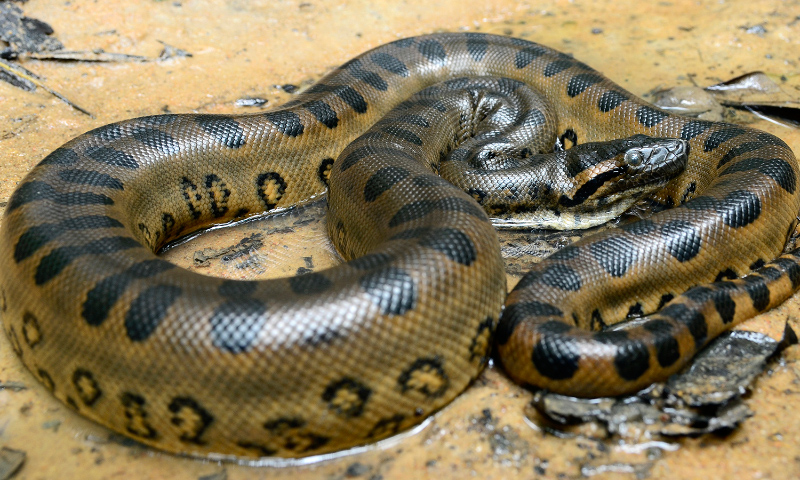
It is true that in the past there were abundant very large anacondas and that a large specimen is undoubtedly an animal that must be treated with respect and from which it is better to keep your distance.
However, there are very few true reports of anaconda attacks on humans. Rather, humans have mercilessly hunted anacondas, out of fear of them or to take advantage of their skin.
So today it is very difficult to find fabulously sized specimens such as those described by the first Europeans who arrived in South America.
Females inhabit grasslands, staying in areas near riverbanks, basking regularly on elevated areas during the wet season.
Anacondas are able to detect advancing animals using vibrations. They are also capable of detecting chemical signals from nearby airborne animals using their forked tongues and Jacobson’s organs.
Males also use these structures to detect the pheromones of nearby females during the mating season.
Habitat
Anacondas are semi-aquatic snakes that inhabit shallow, slow-moving freshwater habitats, as well as tropical savannahs, grasslands, and rain forests.
This species is particularly common in the Orinoco basin of eastern Colombia, the Amazon River basin of Brazil, and the seasonally flooded grasslands in Llano of Venezuela. other countries in which they can be found are Ecuador, Paraguay, Bolivia, Argentina, Guyana, Peru, Suriname and Trinidad.
Feeding
Anacondas are opportunistic predators. Their diet includes various aquatic and terrestrial vertebrates, such as fish. reptiles, amphibians, birds and mammals. Juvenile anacondas feed on small birds and juvenile alligators.
Threats
It is hunted, both legally and illegally, in many parts of its range for its pelts and for sale in the growing, illegal pet trade.
Local people also frequently kill anacondas under the pretense of protecting farm animals, pets, or even people. However, in many cases, a widespread fear and dislike of snakes results in individuals of this species being persecuted, even when found in remote areas.
Habitat loss and degradation also threaten this species, and even in areas where habitat protection exists, lack of enforcement is allowing illegal deforestation to take place.
Curious Fact
Anacondas are easily adaptable to changes in their environment. such capacity is useful during the annual dry season of floodplain savannahs. In order to survive, the anacondas that inhabit these areas must either find themselves in water or bury themselves in the mud. the anacondas are more active in the afternoon.