
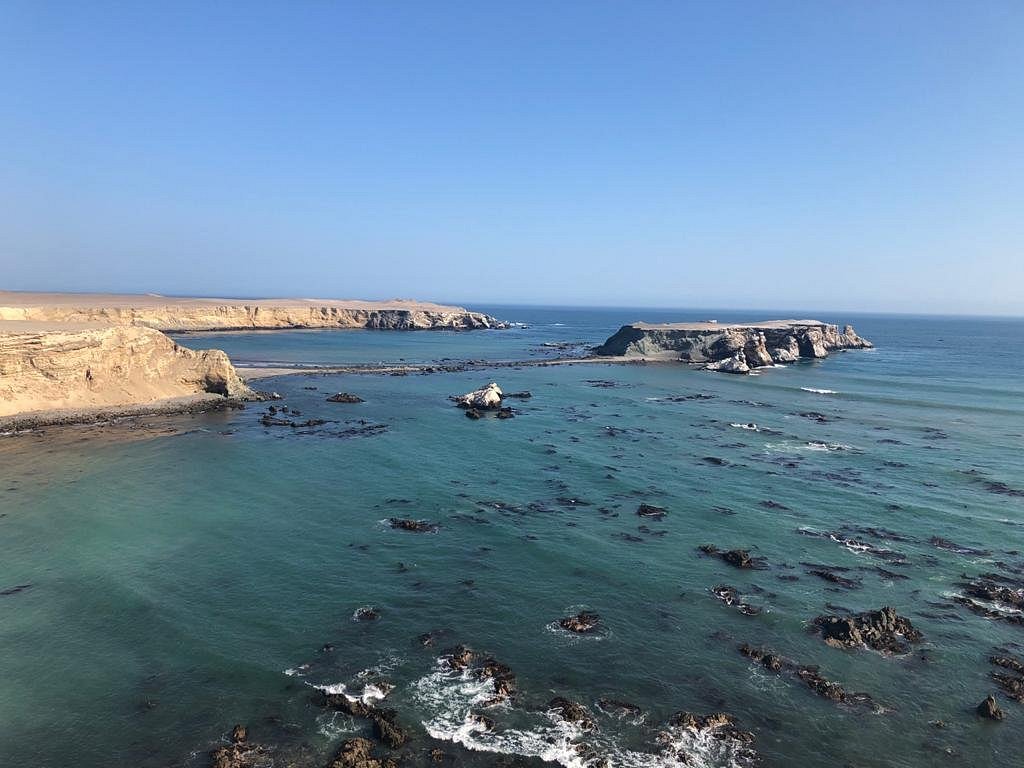
In this bay, the Andean condor flies over the golden dunes and the guanacos, in winter, run through the green hills. This reserve concentrates an extensive marine and marine-coastal biological diversity: Humboldt penguins, tendrils, pelicans, sea otters, oystercatchers, sea lions.
This important ecological zone has an extension of 154,716.37 hectares. Its average temperature is between 17 ºC (63 ºF) and 23 ºC (74 ºF). In the months of December to March there is an increase in fog in the area of the hills.
The San Fernando National Reserve comprises two very different sectors. On the north side there is a relatively accessible area, made up of the mouths of the Ica and Grande rivers, which color the great Ica desert with its riverside forests.
There are also some sandy beaches where seasonal wetlands form near Punta Caballas. In the southern part it includes the San Fernando cove, the coastal hills and the inaccessible cliffs of Cerro Huasipara. This hill is the highest on the Peruvian coast (1790 meters above sea level).
The San Fernando cove, protagonist of the protected area, is a unique geographical accident on the Peruvian coast. It is made up of two points or peninsulas that project into the sea and are very close to each other (parallel) with a large islet in the center.
It concentrates a rich marine and marine-coastal biological diversity, including sea lions, otters, penguins and cetaceans. In the same way, in the area there is typical fauna of the mountains represented by guanacos and condors that descend almost to the marine strip.
The Reserve is the second natural protected area (after the Paracas National Reserve) that protects maritime areas in an area where upwellings in the sea and the resulting biological diversity, marine currents, relict forests, hills, reefs and other geographical accidents, the winds, the scenic beauty, the archaeological values and the isolation, are concentrated, originating priority places for conservation.
Flora and Fauna
The Reserve is home to important species of guano birds such as the guanay (Phalacrocorax bougainvillii), the booby (Sula variegata) and the pelican (Pelecanus thagus); also endangered species such as the Humboldt penguin (Spheniscus humboldti), the chuita (Phalacrocorax gaimardi), the potoyunco (Pelecanoides garnotii) and the Andean condor (Vultur gryphus).
Among the marine mammals are the sea cat or otter (Lontra felina), the fine sea lion (Arctocephalus australis), the chusco sea lion (Otaria byronia), thirteen species of cetaceans, including the humpback whale (Megaptera novaeangliae), the blue (Balaenoptera musculus), fin whale (Balaenoptera physalus), sperm whale (Physeter macrocephalus), bottlenose dolphin (Tursiops truncatus) and killer whale (Orcinus orca).
Among the terrestrial mammals you can see the Andean fox (Pseudalopex culpaeus), the cat of the pajonales (Lynchailurus pajeros), puma (Puma concolor) and guanaco (Lama guanicoe).
Regarding the flora, in the marine environment, various microalgae feed commercial species of fish such as anchoveta, sardines, silverside and mullet. Likewise, the marine flora, represented by various types of algae, serves as a refuge, food and reproduction for invertebrates and fish. The riparian forest of the lower basins presents a rich relict flora of huarango (Prosopis pallida) and toñúz (Pluchea chingoyo), representative of Ica.
Climate
The maximum temperature varies between 26 – 34 °C (summer) and 16 – 26 °C (winter).
Tourist Routes
The San Fernando cove is the main tourist attraction of the place due to its landscape values and its high biological diversity. Tourism is increasing in the area, especially in the area of Punta Caballas.
The Rio Grande is home to a geological park in the surroundings of Cerro Huaricangana, whose top on the edge of the sea offers a unique biological diversity and beautiful panoramic views.