Peru Fruits

peru fruits

Peru is one of the countries with a varity of plants and animals. Peru fruits, vegetables and fish, a land and sea paradise that provides some of the most complete food.

Lucuma:

The delicious lucuma can only be found in Peru

The main health benefits:

  • It provides carbohydrates, vitamins and minerals.
  • It contains beta-carotene, an antioxidant that delays aging.
  • It decreases the chance of heart attacks.
  • It prevents anemia.

Camu Camu:

The red jewel of the Amazon, it is high in vitamin C, containing even more than food with high concentrations of ascorbic acid.

Here are some of its main health benefits:

  • It strengthens the immune system, skin and eyes.
  • It provides vitamin C
  • This fruit promotes collagen growth
  • It is also an anti-oxidant
  • Detoxification of the liver, helping to eliminate toxins

Aguaymanto:

The aguaymanto is considered one of the five healthiest foods produced in Peru. A powerful antioxidant, high in vitamins A, B and C.

Here are some of its main health benefits:

  • It provides vitamin C content
  • It contains antioxidants, perfect for delaying aging and healing wounds.
  • It improves the immune system and increases the production of red blood cells.
  • It corrects cardiovascular function and acts as a natural tranquilizer.

Chirimoya:

Chirimoya looks like a tropical fruit, like banana or pineapple, but this product couldn’t be further from the Caribbean. It grows around 5,000 feet above sea level, on the slopes of the Andes mountain range.

Here are some of its main health benefits:

  • It is high in fiber, vitamin B and potassium.
  • It is a good source of Vitamin C
  • It acts as a powerful antioxidant, protecting our cells from oxidation.

Machu Picchu Informations

Find Machu Picchu Informations! Did you know Machu Picchu is a 15th-century Inca citadel situated on a mountain ridge at 2,430 metres above sea level?

It is located in the Cusco Region, in Machupicchu District in Peru, above the Sacred Valley, which is located at 80 kilometres northwest of Cuzco city and through which the Urubamba River flows.

Most archaeologists believe that Machu Picchu was constructed as an estate for the Inca Pachacutec(1438–1472). Machu Picchu Citadel is the most familiar icon of Inca civilization.

The Incas built the estate around 1450 but abandoned it a century later at the time of the Spanish Conquest. Although known locally, it was not known to the Spanish during the colonial period and remained unknown to the outside world until American historian Hiram Bingham brought it to international attention in 1911.

Machu Picchu was declared a Peruvian Historic Sanctuary in 1981 and a UNESCO World Heritage Site in 1983. In 2007, Machu Picchu was voted one of the New Seven Wonders of the World in a worldwide Internet poll.

Machu Picchu Informations: Weather


Machu Picchu is warm and humid during the day and fresh at night. The temperature ranges between 12ºC and 24ºC.

Generally this site is rainy especially between November and March.

Rains and Humidity


From November to March is the rainy season in Machu Picchu, while between April to November is the dry shiny season.

Machu Picchu has part of the Amazon jungle, and the rains are present in all the seasons. In the hottest days it is possible to achieve approximately 26° Celsius, in the coldest early mornings in June and July the temperature can drop to -2 °C. Its annual average temperature is 16 ° C.

It’s really easy to difference between two seasons: the rainy season (November to March) visitors are recommended to bring appropriate clothing and during the strong sun season (April to October), with a notable temperature increase.

The best months to visit Machu Picchu are May to October. Generally in Machu Picchu it is hot during the day and cold at night.

The tourist must be prepared, because the weather has fluctuations.

The ideal thing is carry a backpack,a sweater of wool, a jacket.

During the day the tourist can use a t-shirt and a comfortable pair of pants. In the dry season (May- November) the sun makes us wear sunglasses, a hat and sun block.

Machu Picchu New Entrance Rules


Peru’s Minister of Culture issued new rules governing all visits to the Machu Picchu Sanctuary.

The rules went into effect July 1, 2017, but have since been updated, which is reflected in this post. The biggest changes of note are:

Visits will now be more strictly timed (at four hours in maximum duration).

No re-entry will be allowed without securing a second permit.

Visitors must enter with a guide on their first visit.

Split Entrance Times


According to the new rules, Machu Picchu will be visited in 2 sessions. The new rules were going to come into operation on July 1st of 2017.

It operates in the following way: Morning session: 6 am – 12 pm Afternoon session: 12 pm – 5:30 pm Remember that readmittance is not permitted once visitors have left the site.

The major difference between the morning and afternoon sessions is that admission is more controlled in the morning.

Three established circuits in Machu Picchu


In the new rules, the government has established 3 circuits for visitors to Machu Picchu.

Visitors must decide which route they will take upon arrival to Machu Picchu with their expert guides.

This decision will depend on the visitors’ interests and physical conditions. Some details about the circuits in Machu Picchu are as follows:

Circuit 1.- Is the most complete route, and the most highly recommended one.

It requires you to be a in good physical condition. first takes you to the upper-sector of the citadel where you will have the best view of Machu Picchu itself, and then it goes through the most beautiful and important buildings.

Circuits 2 u0026amp; 3.- Visit the mid and lower-sectors, and are more suitable for those who want a more relaxing visit. Still, they both take you through beautiful places.

Why are there Alternative Circuits?


Find the best Machu Picchu informations related to alternative circuits:

The alternative circuits are open to Machu Picchu visitors in order to give them some extra options and diversify the hikes.

This also helps reduce crowding in the citadel.


Huayna Picchu Mountain

Huayna Picchu Mountain stands behind Machu Picchu. The views from the top are spectacular, and it only takes 45 minutes to go each way, but the route is quite steep.

If you are interested in this experience, you need to book this in advance.

Also, we highly recommend climbing Huayna Picchu with the second group which is scheduled for 10am because the views during this time are so much better.

This ticket is in combination with the general Machu Picchu entrance ticket; it cannot be purchased separately.

According to the new rules, all visitors to Huayna Picchu need to add 2 extra hours (until 2pm) so that they will have enough time to explore Machu Picchu and hike the mountain.

First entrance: 7 am – 8 am
Second entrance: 10 am – 11 am

Machu Picchu Mountain


Machu Picchu mountain stands just to the left of the citadel.

This climb takes about a total of 2 hours to go up and down. The view from the top is absolutely phenomenal, but it needs to be booked in advance.

This ticket must be purchased in combination with the general Machu Picchu entrance ticket; it cannot be purchased separately.

According to the new rules, all visitors to Machu Picchu Mountain will have an extra 3 hours (until 3pm) so that they will have enough time to explore Machu Picchu and the mountain.

First entrance: 7 am – 8 am
Second entrance: 9 am – 10 am


The Sun Gate

The hike up to the Sun Gate is another option. It’s the entrance that hikers on the Classic Inca Trail enter through in order to arrive to Machu Picchu.

It takes 1 hour to hike and is free and available to all. According to the new rules, it can be visited during the morning session or in the afternoon session.

It is still unsure if the government will give at least 1 hour to that people who want to do this extra hike.

Some important Rules that you should consider when you visit Machu Picchu
We really want to provide you Machu Picchu information, you need to know the most important rules that should be taken into consideration so as to avoid any trouble when you are visiting Machu Picchu.

Any backpacks that are more than 26 liters are not permitted during the tour and must be placed in storage (near the entrance).
It is prohibited to enter with food.
It is prohibited to enter with alcoholic beverages.
It is prohibited to enter with umbrellas (hats, ponchos, and raincoats are permitted).
It is prohibited to enter with photographic tripods or any type of camera stand/support. This is only permitted with pre-authorization and the appropriate permit.
It is prohibited to enter with any musical instruments, including megaphones and speakers.
It is prohibited to enter with high-heeled shoes or any shoe with a hard sole. Only soft soles are permitted (like those found in training shoes or walking shoes/boots).
It is prohibited to enter with children’s strollers or prams. Only strap on baby/child carriers are permitted.
It is prohibited to climb or lean on walls or any part of the citadel.
It is prohibited to touch, move or remove any lithic items / structures.
It is prohibited to enter with walking sticks that contain a metal or hard point. Only elderly people and physically-disable people are permitted to enter with a walking stick with a rubber tip.
It is prohibited to get naked, change clothing, lie down, run and/or jump.
It is prohibited to make loud noises, applaud, shout, whistle and sing. The tranquility and character of Machu Picchu must be maintained at all times.
It is prohibited to smoke or use an electronic cigarette.
It is prohibited to feed the resident or wild animals.
It is prohibited to paraglide and to fly any type of drone or small aircraft.
For Buying Machu Picchu Tickets, please visit:

Ticket Machu Picchu

Inti Raymi

Inti Raymi is the most amazing Inca celebration, this ceremony takes place every year on June 24th in Sacsayhuaman fortress and coincides with the winter solstice and harvest time.


The Festival of the Sun


Inti Raymi is presided over by the Inca and his entourage. They represent the most lavish tribute and worship of the sun. After the event, a presentation of music and dance of the four sides of the Tawantinsuyo is offered.
In 1944, a historical reconstruction of the Inti Raymi was directed by Faustino Espinoza Navarro and indigenous actors.
The first reconstruction was based largely on the chronicles of Garcilaso de la Vega and referred only to the religious ceremony.
Since 1944, an annual theatrical representation of the Inti Raymi has been taking place at Saksaywaman on June 24, two kilometers from the original site of celebration in central Cusco. It attracts thousands of tourists and local visitors.
Inti Raymi is still celebrated in indigenous cultures throughout the Andes.
Celebrations involve music, wearing of colorful costumes (most notable the woven aya huma mask), and the sharing of food. In many parts of the Andes though, this celebration has also been connected to the western Catholic festivals of Saint John the Baptist, which falls on the day after the northern solstice (June 21).

Inti Raymi: The Sun Festival

This festival takes place on June 24th of each year in Cusco, Peru. Before the arrival of the Spaniards in Peru in 1532, the Inti Raymi was the most important holiday of the Inca Empire, during which the sovereign, son of the Sun, thanked his father for the past agricultural year and asked for clemency for the news to come.
This event took place during the winter solstice, the shortest day of the year thus marking the beginning of a new cycle. The festivities were banned in 1572.
They ceased to be celebrated in public, but it is thought that they continued to be secretly. It was in 1944 that the party was brought up to date in the form of a pageant.
The performance begins in front of the Qorikancha (Temple of the Sun) around 8:30 am: hundreds of dancers, playing the inhabitants of the four Suyu (parts) of the empire, present themselves to the public
Then the Inca appears at the top of the temple. He leaves then with his wife the Qoya and goes to the Place d’Armes, where he arrives around 11am. From there, the actors go up to Saqsayhuamán where the last part of the show takes place, from 13h30 to 16h approximately.
Where to see The Inti Raymi
The representation in the city center of Cusco is free, and therefore very busy.
It is therefore advisable to visit the premises early. The access to Saqsayhuamán being totally blocked at the beginning of the afternoon, the easiest way is to go there on foot.
The entry to the stands is not free (between 90 and 130 USD depending on the location).

Peru Wildlife Observation

peru-wildlife-observation

Peru wildlife observation attracts thousands of nature-lovers each year.
Peru Wildlife offers a top destination for birdwatchers and wildlife enthusiasts.

Bird Watching

Peru is the ideal destination for “bird watching” due to geographical and climactic factors that have allowed over 1,830 species to thrive in the country.

Observation of land mammals

Peru is a megadiverse country, containing 84 of the 114 life zones, 8 bio-geographical provinces and three large basins.


Watching Wales and Other Marine Mammals

The Peruvian sea is thome of 33 species of marine mammals (whales) who inhabit different points along the peruvian coast. The Amazon River also boasts species such as otters and pink dolphins, whose unique beauty and color are truly astonishing.

Orchid Spotting

The orchids attracts thousands of tourists to Peru who are interested in seeing them in their natural state.


Butterfly Watching

Peru holds the world record of butterfly species, with approximately 4,000 species, 59 of which are endemic.


Amphibian Spotting

Peru’s rich bio-diversity includes organisms that live inside the soil fauna.

Chinchilla Rat in the Sanctuary of Machu Picchu

chinchilla rat in machu picchu

A species that for many years was considered extinct was found in the Historic Sanctuary of Machu Picchu (Cusco). This is the Machu Picchu tree chinchilla rat (Cuscomys Oblativus), whose last sighting was recorded in 2009.

The important finding was made as part of a study of the biodiversity in the protected natural area, through the installation of camera traps between April 2018 and April 2019, in three sectors of montane forests within the Sanctuary: Winaywayna, Intipata and Kantupata between 2,650 and 3,430 meters above sea level.

The study was developed by researchers Roberto Quispe, specialist from the National Service of Natural Protected Areas by the State (SERNANP); José Ochoa and Norma Jara from the National University of San Antonio Abad del Cusco, and Daniel Cossios from Biosfera Consultores Ambientales.

After 11 years, the second record is made in images of this rodent that is part of the three endemic mammal species of the Historic Sanctuary of Machu Picchu.

According to the researchers, the first evidence of the existence of this species was made in 1916 based on skeletal remains found inside Inca vessels in excavations carried out in the citadel of Machu Picchu.

Since that date, no sighting of this species was obtained until 2009 when the first and only photographic record of this species of rodent was made during a monitoring carried out by SERNANP park rangers and local residents on the Inca trail route between the sectors. from Puyupatamarca and Wiñaywayna at 2,850 meters above sea level.

After 11 years, the second record is made in images of this rodent that is part of the three endemic mammal species of the Historic Sanctuary of Machu Picchu; that is to say, they are unique to this area as no record of them is found outside this protected natural area.

The Best Gifts and Souvenirs from Peru

You will wonder what bringing with you back from Peru to please your loved ones. In this amazing country, you will find markets filled with beautifully colored merchandise that will captivate your view. You will find below the 16 best gifts and souvenirs of Peru.

If you are going to Peru, you will want to take in your suitcase the best gifts and souvenirs from Peru.

lifestyle photography Refreshment Travel

Gifts and Souvenirs from Peru

The chullo or Peruvian Hat

The chullo or Peruvian hat is characterized by its earmuffs that you can attach under your chin. These vicuña, alpaca or sheep wool hats are a practical accessory when you cross the heights of Cusco, Puno or Colca Canyon in the Peru Andes.

Alpaca clothes

Ponchos, scarves and blankets are the best souvenirs that you will find in the markets and shops.
The products made in alpaca are light, hypoallergenic and above all, they do not itch.
The “baby alpaca” clothes are made from the first cut of its wool which is extremely soft. Be careful though, many products are marketed as being 100% baby alpaca wool, but most often it is mixtures of alpaca wool and acrylic or synthetic fibers.
If you want the real product, leave out the markets and visit shops like Kuna where prices reflect quality. Arequipa is where a lot of products are made and if you go there, it will be the best place to buy one.


Musical instruments

Peruvian music is beautiful to listen to and has Andean, Spanish and African influences. If you are inclined to music, you may want to bring a new instrument back home. Choose from a wooden flute, a zampoña made of 11 wooden tubes, a drum or play the 10-string charango. To please a child, a small flute will be welcome.


Backpacks

If you need space to store all the small goods of your trip to Peru, a new backpack is the solution.
You can find many traditional textile backpacks that are on sale in trekking shops. Canvas bags are also available in traditional models and we have seen a few people at the airport make good use of the backpacks.


Textiles

Peruvian traditional clothing and products, from handbags to sweaters, are made from the brightest and most colorful textiles.
There are many beautiful Peruvian fabrics for sale in local markets that you can buy as tablecloths, placemats and pillowcases.
Paintings
The best way to remember your trip to Peru is to take a picture at home to admire it every day and so decorate your home. Women dressed in their native clothes look like a good image as well as the unique landscape of Machu Picchu.
Visit one of the many galleries or approach one of the street vendors selling engravings around the Plaza de Armas in Arequipa, Puno, Lima or Cusco.


The Retablos Altarpieces

The altarpieces are shiny wooden boxes that represent important religious, historical or daily events for Peruvians.
The delicate figures inside the boxes sometimes appear on two levels: the upper level symbolizes the sky and the sacred animals of the Andes, while the lower level symbolizes life on earth. The sizes and prices are varied and the scenes they contain.


The Peruvian Pisco

Pisco, this alcohol at 38% -48% is the basic ingredient of the Peruvian national drink, Pisco Sour. Many tours and hikes in Peru end with a demonstration of the preparation of Pisco Sour and you will not want to leave the country without tasting this drink.


A Chakana or necklace with an Inca cross

These necklaces may only look like geometric figures, but after your trip to Peru, you’ll know it’s the Inca Cross or Chakana and it has deep meaning and importance to the Quechua people.
You will see the sculpture in several archaeological sites. In short, the hole in the center represents the city of Cusco, capital of the Inca Empire, and the Cruz del Sur constellation.
The cross is divided into four quadrants of 3 corners each. The first quadrant represents the levels of the world: the lower world of death, the intermediate world of human life, and the higher world of gods and celestial beings.
The second represents the venerated animals of each world: the snake, the andean puma and the condor.
The third symbolizes the three commandments of the Incas: do not steal, do not lie and do not be lazy and the fourth represents the human principles: love and doing good, wisdom and work.


The Pucara Bulls

The bulls of Pucara are offered as a wedding gift to Peruvian couples. If you look closely at the roofs of Peru in Cusco or Puno, you may see some of these bulls that are supposed to bring fertility, prosperity, joy and protection to the house. If you want to wish the same luck to someone, then you will want to give him a Pucara bull.


Ekeko, the god of prosperity

Ekeko is the god of abundance, prosperity and good fortune. Instead of buying one for yourself, you should give it to someone you want to succeed. Small offerings to the god are what the person hopes to receive or realize.
Andean dolls
These Andean dolls are an excellent gift for little girls who will learn about the lifestyle, clothing and culture of traditional Peruvian women.

Peru Flora and Fauna

Peru’s several climates and contrasting surface features have produced a rich diversity of Peru flora and fauna.

Peru Flora

Perennial shrubs, candelabra cacti, and intermontane pepper trees account for much of the western slope vegetation in the higher altitudes and forests of eucalyptus have been planted. High-altitude vegetation varies from region to region, depending on the direction and intensity of sunlight.
Tola grows at 3,400 meters in the southern volcanic regions; bunch puna grasses may be found at 3,700 meters. On the brow (ceja) of the eastern slopes, mountain tall grass and sparse sierra cactus and low shrub give way at 900 meters to rain forests and subtropical vegetation.
As the eastern slopes descend, glaciers are remarkably close to tropical vegetation.
The native plants as sarsaparilla, barbasco, cinchona, coca, ipecac, vanilla, leche caspi, and curare have become commercially important, as well as the wild rubber tree, mahogany, and other tropical woods.
Discover the Colca Canyon by horse ride


Fauna in Peru

Andean Condor

For centuries, vast colonies of pelicans, gannets, and cormorants have fed on the schools of anchovies that graze the rich sea pastures of the Humboldt Current and have deposited their excrement on the islands to accumulate, undisturbed by weather, in great quantities of guano.
This natural fertilizer was used by the pre-Inca peoples. Forgotten during the days of colonial gold greed, guano attracted the attention of scientists in 1849, when its rich nitrogen content was analyzed as 14–17%.
The rich marine plant life off the Peruvian coast attracts a wealth of marine fauna, the most important of which are anchoveta, tuna, whale, swordfish, and marlin.
Characteristic of the Andes are the great condor, ducks, and other wild fowl. The vizcacha, a mountain rodent, and the chinchilla are well known, as is the puma, or mountain lion. Peru is famous for its American members of the camel family—the llama, alpaca, huarizo, and guanaco—all typical grazing animals of the highlands.
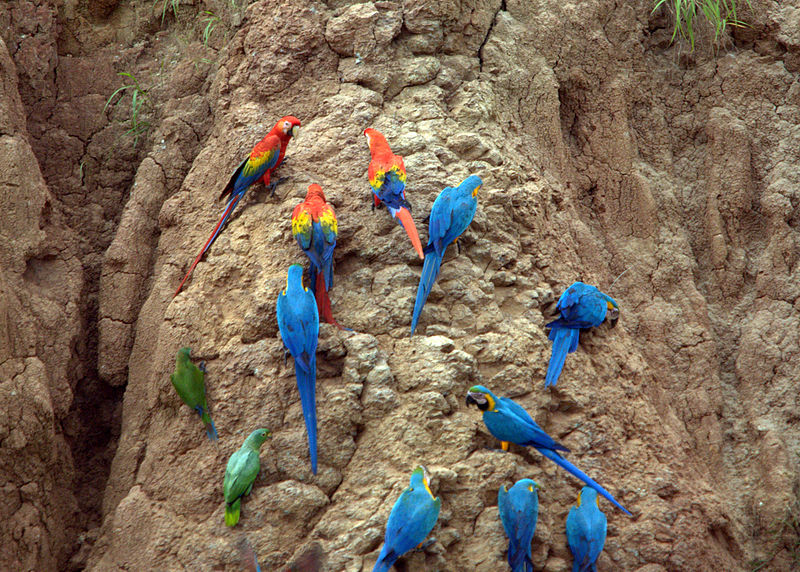
The humid forests and savannas of eastern Peru contain almost half the country’s species of fauna, including parrots, monkeys, sloths, alligators, paiche fish, piranhas, and boa constrictors, all common to the Amazon Basin.

The Andean condor (Vultur gryphus) has an important ecological role as a scavenger.
By quickening the decomposition rate of dead animals, thus diminishing the risk of disease associated with the slow rotting of cadavers.
It also has evolutionarily importance due to its sense of smell, unique in its genus and unusual in the bird kingdom. It has a long lifespan, comparable to humans, with up to 50 years in the wild, and up to 80 years in captivity.
It is around 142 cm tall and its wingspan can reach 330 cm. Its distribution range spreads through the Andean countries of Peru, Ecuador, and Bolivia, from the north of Colombia to the extreme south of the Chilean and Argentine Patagonia.
Since ancient times, the Andean condor has been an important part of the Andean mythology and traditions.
One of the most important places for watching the condor’s fligh is the Mirador de la Cruz del Condor in Arequipa region.

10 facts about the Andean Condor:

Its name in quechua is kuntur and the Incas believed it was immortal.
The distance between the points of its spread wings (3.3 meters) represents the largest wingspan of any terrestrial bird.
The Andean condor is part of four national shields, where it represents different values: Bolivia (boundaryless pursuit), Chile (strength), Colombia (liberty and order), and Ecuador (power, grandeur, and valeur.
This bird is monogamous and both parents incubate the egg. Its chicks stay with its parents up to 2 years before facing the world.
In certain seasons of the year (October in Peru), the Andean condor flies from the peaks of the Andes to the Pacific coast to eat sea lion carcasses and discarded placentas.
It’s one of the only predators that can break the hard guanaco skin.
Andean condors mature sexually late in life (a minimum of 5 years, with reports of the first chick at 11 years), and they only have one chick every 2-3 years.
They form part of the family Cathartidae, which comes from the Greek word kathartes meaning “he who cleans.”
Andean condors are thermal soarers, which means that they rise with the air current, helping them spot carcasses from great heights and descend upon them without wasting much energy.
The Andean condor displays sexual dimorphism– this is when animals of the same species have different body forms based on biological sex.
The male Andean condor has a white collar and a crest, while the female Andean condor does not.

Travel to Cusco during the Rain Season

travel to cusco during the rain season

Why you should travel to Cusco during the rain season? It is always a good time to travel and escape from routine. Cusco offers a wide variety of attractions that can be visited during all year. For example, there are amazing natural landscapes that can only be enjoyed during the rainy season from November to March.

Many people believe during this season it rains all day and every day, but no, the truth is that the months of strongest rainfall are January and February and, despite this, tourism can be done without problems.

Warm weather

The summer in the city of Cusco occurs during the rainy season, which means that in this season you can enjoy a clear sky full of light in the morning, with a possible rain in the afternoon that, however it may seem very strong, it will only last a couple of hours and then clear again.

Awesome landscapes

The rains make a panorama full of herbs, flowers and seasonal fruits that surprises tourists for their striking colors and the intense green of the mountains.

Less tourists

During this time of the year the tourism decreases, this fact allows to access to various historical structures and taking pictures with no tourist around.

Gastronomic variety

In this season you can find a great diversity of exotic fruits and vegetables, such as capulí, pacay, mushrooms or turnip. Also delicious dishes are prepared that can only be tasted during the rainy season.

Thus, one of the best moments to get to know the City of the Incas is undoubtedly the rainy season, so do not forget to include trekking or non-slip shoes, a waterproof jacket and, most importantly, sunscreen.

Santa Catalina Monastery The place You can’t Skip

arequipa tours

Arequipa has a different plan for each type of traveler. For lovers of quiet walks, the Yanahuara viewpoint is a fixed route; while for the more adventurous, a more demanding plan is the Colca Canyon.

But if you want to visit an attraction that combines history, beautiful environments, and close to the city center, the Monastery of Santa Catalina has everything you need to make your trip a memorable experience.

Cloisters, squares, tile roofs and cobbled floors are part of the Monastery of Santa Catalina, which was inaugurated in 1580 as an absolute cloister center for nuns. Its preserved and colorful environments will catch you from the start.

Located in the Historic Center of Arequipa, the Santa Catalina Monastery is a magical place that will transport you through the history of the White City.

– It is one step away from the city center

It won’t take you long to get to the monastery. Being located on Santa Catalina Street 301, in the historic center of Arequipa, gives you the opportunity to continue visiting other charms of the city.

– There are promotions for university students

Although the general entrance to the Monastery of Santa Catalina has a cost of S / 40, this tourist attraction offers promotions for children under 7 years (free admission), national schoolchildren (S / 6) and peruvian university students with a valid card (S / 12). In addition, peruvian adults, on the 10th and last Sunday of each month, can pay S / 10.

About the guides

Visitors can do the tour on their own, but it is much better to do it with a specialized guide.If you want to hire this service, keep in mind that the rates are from 1 to 4 people (S / 20).

You can do night tours

Organize your travel itinerary in the White City with time. Keep in mind that the opening hours at the Monastery of Santa Catalina are from Thursday to Monday from 8:00 a.m. at 5:00 p.m. Also, on Tuesdays and Wednesdays, you can take the tour from 8:00 a.m. until 8:00 p.m.

Peruvian Dishes to Taste

peruvian dishes to taste

These are the best peruvian dishes to taste during your trip to Peru. Peruvian food reflects traditional flavors of the coast, mountains and jungle to delight you with the varied and generous gastronomic offer of Peru.

Puka Picante: Its reddish color is due to beetles, chili pepper and peanuts. But the Ayacuchanas ladies say that, in the past, this stew was made with ayrampo, the black fruit of a bush that, at some point, abounded in Huancavelica. Try it at Restobar Andes.

Cuy Chactado: Served with golden potatoes and onion bramble. Usually requested in more traditional picanterías like La Lucila, in the district of Sachaca in Arequipa city.

Brochetas de Suri: They eat them roasted, in the market with slices of onion and grilled red paprika, accompanied by fried yucas or regional sausage in the sophisticated Fitzcarraldo restaurant, overlooking the Itaya River. (Calle Napo 100, corner with Boulevard Joaquín Abensur, Iquitos. Tel. (065) 507545).

Cebiche de Conchas Negras: The best cebiche can be eaten at Don Teófilo Imán Ipanaqué, owner of Chimú, an small and cozy restaurant offering delicious food.

Chicharron de Conejo a la Naranja: This dish is prepred in Lima. If you are passing through Barranco, visit Café Tostado. You can find it in Nicolás de Piérola 222. (Tel. (01) 2477133).

Adobo Arequipeño: In Sabor Caymeño (from Mrs. María Meza), located on the corner of the Plaza de Armas de Cayma, you will learn why pork marinated with chicha de jora, garlic, onions and cloves, provides you energy.

Cebiche de Mango con Langostinos: They prepare it at the Ñaylamp restaurant, in Los Órganos, Piura. In addition, you will find other dishes at reasonable prices, such as lobster and jumbo prawns with a handmade pasta.

No matter where you go, the peruvian food is delicious

Grilled Alpaca: In southern Peru, alpaca meat is grilled. You can enjoy, especially, in Cusco, Puno or Arequipa. The restaurant that you must visit to try it is the Zigzag, located at 210-212 Zela Street, Historic Center of Arequipa. (Tel. (054) 206020).

Picante de Cuy: It is not a cheap product and, rather, is offered on special occasions. Ask for one at the Casita Rustika de Huaraz, (943-785-329).

Cebiche de Chocho: The cchocho is a legume that is consumed in the Andean region. Thus, instead of fish or shellfish, chocho is used. The restaurant to taste it is Tambo, in Huaraz (Tel. (043) 425859).

Pallares Salad: The richest is in La Olla de Juanita, in the Subtanjalla neighborhood, north of the city of Ica, which is the land of pallares (Tel. (056) 403317).