
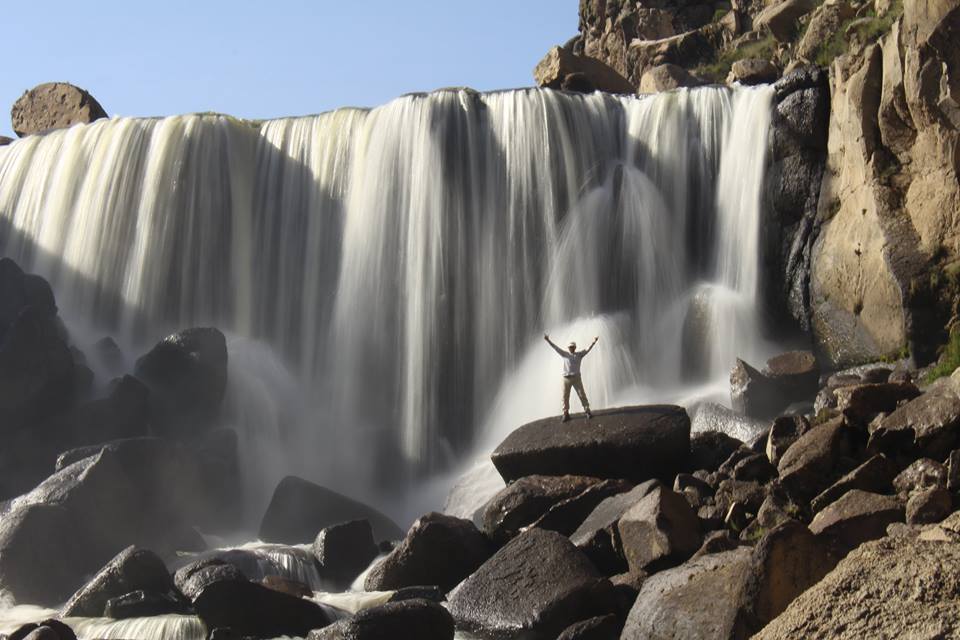
Pillones Enjoy Nature in Arequipa

Arequipa is not only it’s ashlar buildings or the excellent gastronomy. Take the advantage of your trip to the White City and discover an alternative destination: Pillones waterfalls, at 4600 m.a.s.l.

For seeing this natural spectacle you must go to the district of San Antonio de Chuca, in the Arequipa, Caylloma, in the 154 kilometer of the Arequipa-Puno road. From this point you must do a 30-minute walk to the left side towards the river. The entrance to the place is S / 2.

Enjoy and relax with the Sounds of Nature’s Symphony at Pillones falls

The best option to reach Pillones with total security is to take a tour from Arequipa. The price includes transfers and an english speaking guide. Remember to go with warm clothes and trekking shoes. In your backpack you can not miss a bottle of water and snacks for the road.

The tour is complemented by a visit to the Imata stone forest. You will spend a nice time in this hidden wonder, you will realize that all efforts were worth it.

When to go?

You can visit this attraction at any time of the year; However, you should consider that during the rainy season (January to March) you can see more water. Do not wait anymore and book a Pillones waterfall tour.

Q’eswachaka The Last Inca Bridge

Located at three hours driving from Cusco (Peru) the Q’eswachaka bridge, which crosses the Apurimac River, has become an important tourist attraction that has gained fame among travelers. The reason: it is the last suspension bridge of the Inca culture, so crossing it is a unique experience for any tourist.

Queshuachaca (possibly from Quechua q’iswa a rope of twisted dried maguey or ichhu, chaka bridge, “rope bridge”, consisting of ropes made of grass and spanning the Apurimac River near Huinchiri, in Quehue District, Canas Province, Peru, is the last remaining Inca rope bridge

Located in the district of Quehue, in the Cusco province of Canas, this impressive bridge made of vegetable fiber (ichu) was part of the Inca Trail. Its validity is approximately 600 years.

At 50 meters high, the 28 meters long and 1.20 wide of the Q’eswachaka are a challenge for tourists. Therefore, every year in June, such construction is renewed by the local communities of Winch’iri, Chaupibanda, Ccollana Quehue and Perccaro. It is a ritual that lasts three days.

Andean Condor National Bird of Peru

The Andean Condor National Bird of Peru (Vultur gryphus) is known as the largest flying bird on the planet, this is a Western South American bird and could be found in the Andes. The Andean condor is the largest flying bird in the world by combined measurement of weight and wingspan.

The Vultur Gryphus is a national symbol of Argentina, Bolivia, Chile, Colombia, Ecuador, and Peru and plays an important role in the folklore and mythology of the Andean regions.

The Andean condor can easily live up to 85 years, therefore it is called the “eternal bird” and is characterized by being sedentary and monogamous. It can measure up to 1.30 meters tall, 3.30 meters wide and its maximum weight is 12 kg.


The adult plumage is black, with the exception of a frill of white feathers nearly surrounding the base of the neck especially in the male.

The head and neck are red to blackish-red and have few feathers. In the male, the head is crowned with a dark red caruncle or comb, while the skin of his neck lies in folds. Juveniles have a grayish-brown general coloration, blackish head and neck skin.


The Colca Canyon in Arequipa, Peru is one of the sites, recognized worldwide, as the condor’s habitat where you can observe the flight of this bird.


The Andean Condor and The Incas of Peru

In Andean mythology, the Andean condor was associated with the Inti or sun deity. This bird is considered a symbol of power and health. In some Peruvian bullfighting, a condor is tied to the back of a bull, where it pecks at the animal as bullfighters fight it.

The condor generally survives and is set free.

This ceremony is called Yawar Fiesta which is a symbolic representation of the power of the Andean peoples (the condor) over the Spanish (the bull).

The Best Places for Watching Condors in Peru

These extraordinary birds can live in very high areas with mountainous regions. Among these places are the Colca Canyon in Arequipa, the Moyobamba canyon in Ayacucho or in Chonta, located in Cusco.

Many condors have also been sighted in coastal areas, near the sea. Outside of Peru, they can be found throughout the Andes, from Colombia to Chile.

They can be seen in areas of Argentina, Ecuador and much of Bolivia.