
Andean Condor National Bird of Peru

The Andean Condor National Bird of Peru (Vultur gryphus) is known as the largest flying bird on the planet, this is a Western South American bird and could be found in the Andes. The Andean condor is the largest flying bird in the world by combined measurement of weight and wingspan.

The Vultur Gryphus is a national symbol of Argentina, Bolivia, Chile, Colombia, Ecuador, and Peru and plays an important role in the folklore and mythology of the Andean regions.

The Andean condor can easily live up to 85 years, therefore it is called the “eternal bird” and is characterized by being sedentary and monogamous. It can measure up to 1.30 meters tall, 3.30 meters wide and its maximum weight is 12 kg.


The adult plumage is black, with the exception of a frill of white feathers nearly surrounding the base of the neck especially in the male.

The head and neck are red to blackish-red and have few feathers. In the male, the head is crowned with a dark red caruncle or comb, while the skin of his neck lies in folds. Juveniles have a grayish-brown general coloration, blackish head and neck skin.


The Colca Canyon in Arequipa, Peru is one of the sites, recognized worldwide, as the condor’s habitat where you can observe the flight of this bird.


The Andean Condor and The Incas of Peru

In Andean mythology, the Andean condor was associated with the Inti or sun deity. This bird is considered a symbol of power and health. In some Peruvian bullfighting, a condor is tied to the back of a bull, where it pecks at the animal as bullfighters fight it.

The condor generally survives and is set free.

This ceremony is called Yawar Fiesta which is a symbolic representation of the power of the Andean peoples (the condor) over the Spanish (the bull).

The Best Places for Watching Condors in Peru

These extraordinary birds can live in very high areas with mountainous regions. Among these places are the Colca Canyon in Arequipa, the Moyobamba canyon in Ayacucho or in Chonta, located in Cusco.

Many condors have also been sighted in coastal areas, near the sea. Outside of Peru, they can be found throughout the Andes, from Colombia to Chile.

They can be seen in areas of Argentina, Ecuador and much of Bolivia.
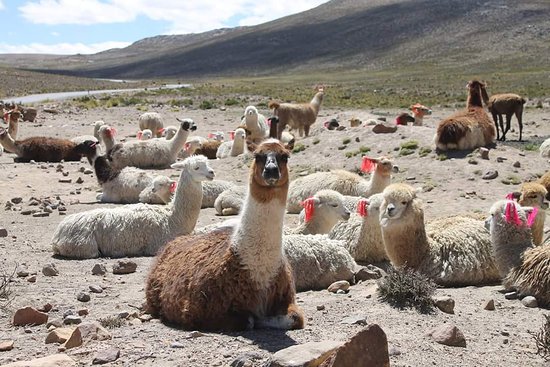
Differences between llamas and alpacas

Is It easy to find the differences between llamas and alpacas?
The recreation of Andean cuisine draws on elements from other cultural landscapes, such as Europe.
What better way to combine healthy cuisine with Novo Andean flavors in Peru, yielding an intense variety of dishes that delight even the most discerning palates.
Discover which foods and ingredients from Peruvian cuisine make Peru a good destination to visit and enjoy.
Differences between Llamas and alpacas: Alpacas may seem very similar to the llamas, but there is a variety of differences between them.
Colca Trek 3 Days inside the second deepest Canyon in the world
Differences between the llamas vs alpacas:

  1. Ears: An alpaca has straight, pointed ears. A llama on the other hand has banana shaped ears.
  2. Wool: Llamas have no wool, rather hair that protects but is not appropriate for a sweater or scarf. Alpacas are bred purely for their luxurious wool which is one of the finest in the world.
  3. Face: The face of an alpaca is a lot fuzzier and woollier than a llamas face. A llamas face is also longer while an alpaca’s face is a bit more blunt.
  4. Size: The llama is a lot bigger while alpacas are a lot lighter. The llama can have a height of more than 110 cm, alpacas are generally not much taller than 90 cm.
  5. Purpose: Llamas are known as the “Ship of the Andes”. Their back is very suitable to carry heavy weights for long distances. Alpacas on the other hand, are all wool.
  6. Personality: Alpacas are very gentle and shy while llamas are very confident and brave animals.
  7. Strength: Alpacas can’t protect themselves and need protection. Llamas on the other hand can and will protect themselves.
  8. Character: Alpacas are very intelligent and can learn tricks. Llamas seem to be too confident/proud and arrogant.
  9. Like minded: Alpacas are 100% herd animals and need tot be in a group to survive while llamas are more independent.
  10. Llamas are known for spitting quickly when they feel threatened, whereas alpacas are much more gentle and just spit as their last resort when they’re really angry or scared.

Ultricies mi eget mauris pharetra et ultrices neque ornare aenean. Neque aliquam vestibulum morbi blandit cursus risus at. Eget egestas purus viverra accumsan. In hendrerit gravida rutrum quisque non tellus orci. Cursus euismod quis viverra nibh cras pulvinar mattis nunc. Imperdiet dui accumsan sit amet.

Header 1

Header 2

Header 3

Header 4

Aliquam ultrices sagittis orci a scelerisque purus. Etiam dignissim diam quis enim lobortis scelerisque

Aliquam ultrices sagittis orci a scelerisque purus. Etiam dignissim diam quis enim lobortis scelerisque fermentum dui. Aliquet eget sit amet tellus cras adipiscing enim eu turpis. Neque gravida in fermentum et. Donec massa sapien faucibus et molestie ac feugiat.

lifestyle photography Refreshment Travel

Tempus imperdiet nulla malesuada pellentesque elit eget gravida. Adipiscing diam donec adipiscing tristique risus nec feugiat in fermentum. Sed felis eget velit aliquet sagittis id consectetur purus ut. Convallis tellus id interdum velit. Quam quisque id diam vel quam elementum pulvinar etiam.