The Best Gifts and Souvenirs from Peru

You will wonder what bringing with you back from Peru to please your loved ones. In this amazing country, you will find markets filled with beautifully colored merchandise that will captivate your view. You will find below the 16 best gifts and souvenirs of Peru.

If you are going to Peru, you will want to take in your suitcase the best gifts and souvenirs from Peru.

lifestyle photography Refreshment Travel

Gifts and Souvenirs from Peru

The chullo or Peruvian Hat

The chullo or Peruvian hat is characterized by its earmuffs that you can attach under your chin. These vicuña, alpaca or sheep wool hats are a practical accessory when you cross the heights of Cusco, Puno or Colca Canyon in the Peru Andes.

Alpaca clothes

Ponchos, scarves and blankets are the best souvenirs that you will find in the markets and shops.
The products made in alpaca are light, hypoallergenic and above all, they do not itch.
The “baby alpaca” clothes are made from the first cut of its wool which is extremely soft. Be careful though, many products are marketed as being 100% baby alpaca wool, but most often it is mixtures of alpaca wool and acrylic or synthetic fibers.
If you want the real product, leave out the markets and visit shops like Kuna where prices reflect quality. Arequipa is where a lot of products are made and if you go there, it will be the best place to buy one.


Musical instruments

Peruvian music is beautiful to listen to and has Andean, Spanish and African influences. If you are inclined to music, you may want to bring a new instrument back home. Choose from a wooden flute, a zampoña made of 11 wooden tubes, a drum or play the 10-string charango. To please a child, a small flute will be welcome.


Backpacks

If you need space to store all the small goods of your trip to Peru, a new backpack is the solution.
You can find many traditional textile backpacks that are on sale in trekking shops. Canvas bags are also available in traditional models and we have seen a few people at the airport make good use of the backpacks.


Textiles

Peruvian traditional clothing and products, from handbags to sweaters, are made from the brightest and most colorful textiles.
There are many beautiful Peruvian fabrics for sale in local markets that you can buy as tablecloths, placemats and pillowcases.
Paintings
The best way to remember your trip to Peru is to take a picture at home to admire it every day and so decorate your home. Women dressed in their native clothes look like a good image as well as the unique landscape of Machu Picchu.
Visit one of the many galleries or approach one of the street vendors selling engravings around the Plaza de Armas in Arequipa, Puno, Lima or Cusco.


The Retablos Altarpieces

The altarpieces are shiny wooden boxes that represent important religious, historical or daily events for Peruvians.
The delicate figures inside the boxes sometimes appear on two levels: the upper level symbolizes the sky and the sacred animals of the Andes, while the lower level symbolizes life on earth. The sizes and prices are varied and the scenes they contain.


The Peruvian Pisco

Pisco, this alcohol at 38% -48% is the basic ingredient of the Peruvian national drink, Pisco Sour. Many tours and hikes in Peru end with a demonstration of the preparation of Pisco Sour and you will not want to leave the country without tasting this drink.


A Chakana or necklace with an Inca cross

These necklaces may only look like geometric figures, but after your trip to Peru, you’ll know it’s the Inca Cross or Chakana and it has deep meaning and importance to the Quechua people.
You will see the sculpture in several archaeological sites. In short, the hole in the center represents the city of Cusco, capital of the Inca Empire, and the Cruz del Sur constellation.
The cross is divided into four quadrants of 3 corners each. The first quadrant represents the levels of the world: the lower world of death, the intermediate world of human life, and the higher world of gods and celestial beings.
The second represents the venerated animals of each world: the snake, the andean puma and the condor.
The third symbolizes the three commandments of the Incas: do not steal, do not lie and do not be lazy and the fourth represents the human principles: love and doing good, wisdom and work.


The Pucara Bulls

The bulls of Pucara are offered as a wedding gift to Peruvian couples. If you look closely at the roofs of Peru in Cusco or Puno, you may see some of these bulls that are supposed to bring fertility, prosperity, joy and protection to the house. If you want to wish the same luck to someone, then you will want to give him a Pucara bull.


Ekeko, the god of prosperity

Ekeko is the god of abundance, prosperity and good fortune. Instead of buying one for yourself, you should give it to someone you want to succeed. Small offerings to the god are what the person hopes to receive or realize.
Andean dolls
These Andean dolls are an excellent gift for little girls who will learn about the lifestyle, clothing and culture of traditional Peruvian women.

Peru Flora and Fauna

Peru’s several climates and contrasting surface features have produced a rich diversity of Peru flora and fauna.

Peru Flora

Perennial shrubs, candelabra cacti, and intermontane pepper trees account for much of the western slope vegetation in the higher altitudes and forests of eucalyptus have been planted. High-altitude vegetation varies from region to region, depending on the direction and intensity of sunlight.
Tola grows at 3,400 meters in the southern volcanic regions; bunch puna grasses may be found at 3,700 meters. On the brow (ceja) of the eastern slopes, mountain tall grass and sparse sierra cactus and low shrub give way at 900 meters to rain forests and subtropical vegetation.
As the eastern slopes descend, glaciers are remarkably close to tropical vegetation.
The native plants as sarsaparilla, barbasco, cinchona, coca, ipecac, vanilla, leche caspi, and curare have become commercially important, as well as the wild rubber tree, mahogany, and other tropical woods.
Discover the Colca Canyon by horse ride


Fauna in Peru

Andean Condor

For centuries, vast colonies of pelicans, gannets, and cormorants have fed on the schools of anchovies that graze the rich sea pastures of the Humboldt Current and have deposited their excrement on the islands to accumulate, undisturbed by weather, in great quantities of guano.
This natural fertilizer was used by the pre-Inca peoples. Forgotten during the days of colonial gold greed, guano attracted the attention of scientists in 1849, when its rich nitrogen content was analyzed as 14–17%.
The rich marine plant life off the Peruvian coast attracts a wealth of marine fauna, the most important of which are anchoveta, tuna, whale, swordfish, and marlin.
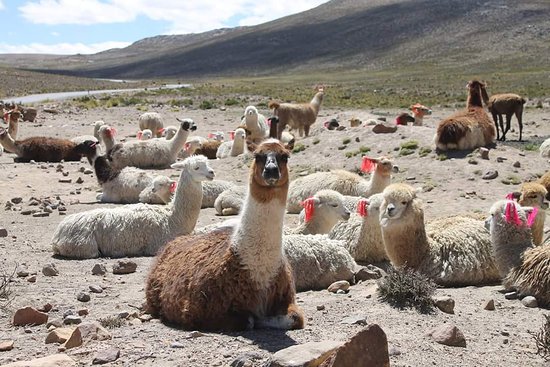
Characteristic of the Andes are the great condor, ducks, and other wild fowl. The vizcacha, a mountain rodent, and the chinchilla are well known, as is the puma, or mountain lion. Peru is famous for its American members of the camel family—the llama, alpaca, huarizo, and guanaco—all typical grazing animals of the highlands.
The humid forests and savannas of eastern Peru contain almost half the country’s species of fauna, including parrots, monkeys, sloths, alligators, paiche fish, piranhas, and boa constrictors, all common to the Amazon Basin.

The Andean condor (Vultur gryphus) has an important ecological role as a scavenger.
By quickening the decomposition rate of dead animals, thus diminishing the risk of disease associated with the slow rotting of cadavers.
It also has evolutionarily importance due to its sense of smell, unique in its genus and unusual in the bird kingdom. It has a long lifespan, comparable to humans, with up to 50 years in the wild, and up to 80 years in captivity.
It is around 142 cm tall and its wingspan can reach 330 cm. Its distribution range spreads through the Andean countries of Peru, Ecuador, and Bolivia, from the north of Colombia to the extreme south of the Chilean and Argentine Patagonia.
Since ancient times, the Andean condor has been an important part of the Andean mythology and traditions.
One of the most important places for watching the condor’s fligh is the Mirador de la Cruz del Condor in Arequipa region.

10 facts about the Andean Condor:

Its name in quechua is kuntur and the Incas believed it was immortal.
The distance between the points of its spread wings (3.3 meters) represents the largest wingspan of any terrestrial bird.
The Andean condor is part of four national shields, where it represents different values: Bolivia (boundaryless pursuit), Chile (strength), Colombia (liberty and order), and Ecuador (power, grandeur, and valeur.
This bird is monogamous and both parents incubate the egg. Its chicks stay with its parents up to 2 years before facing the world.
In certain seasons of the year (October in Peru), the Andean condor flies from the peaks of the Andes to the Pacific coast to eat sea lion carcasses and discarded placentas.
It’s one of the only predators that can break the hard guanaco skin.
Andean condors mature sexually late in life (a minimum of 5 years, with reports of the first chick at 11 years), and they only have one chick every 2-3 years.
They form part of the family Cathartidae, which comes from the Greek word kathartes meaning “he who cleans.”
Andean condors are thermal soarers, which means that they rise with the air current, helping them spot carcasses from great heights and descend upon them without wasting much energy.
The Andean condor displays sexual dimorphism– this is when animals of the same species have different body forms based on biological sex.
The male Andean condor has a white collar and a crest, while the female Andean condor does not.

Santa Catalina Monastery The place You can’t Skip

Arequipa has a different plan for each type of traveler. For lovers of quiet walks, the Yanahuara viewpoint is a fixed route; while for the more adventurous, a more demanding plan is the Colca Canyon.

But if you want to visit an attraction that combines history, beautiful environments, and close to the city center, the Monastery of Santa Catalina has everything you need to make your trip a memorable experience.

Cloisters, squares, tile roofs and cobbled floors are part of the Monastery of Santa Catalina, which was inaugurated in 1580 as an absolute cloister center for nuns. Its preserved and colorful environments will catch you from the start.

Located in the Historic Center of Arequipa, the Santa Catalina Monastery is a magical place that will transport you through the history of the White City.

– It is one step away from the city center

It won’t take you long to get to the monastery. Being located on Santa Catalina Street 301, in the historic center of Arequipa, gives you the opportunity to continue visiting other charms of the city.

– There are promotions for university students

Although the general entrance to the Monastery of Santa Catalina has a cost of S / 40, this tourist attraction offers promotions for children under 7 years (free admission), national schoolchildren (S / 6) and peruvian university students with a valid card (S / 12). In addition, peruvian adults, on the 10th and last Sunday of each month, can pay S / 10.

About the guides

Visitors can do the tour on their own, but it is much better to do it with a specialized guide.If you want to hire this service, keep in mind that the rates are from 1 to 4 people (S / 20).

You can do night tours

Organize your travel itinerary in the White City with time. Keep in mind that the opening hours at the Monastery of Santa Catalina are from Thursday to Monday from 8:00 a.m. at 5:00 p.m. Also, on Tuesdays and Wednesdays, you can take the tour from 8:00 a.m. until 8:00 p.m.

Pillones Enjoy Nature in Arequipa

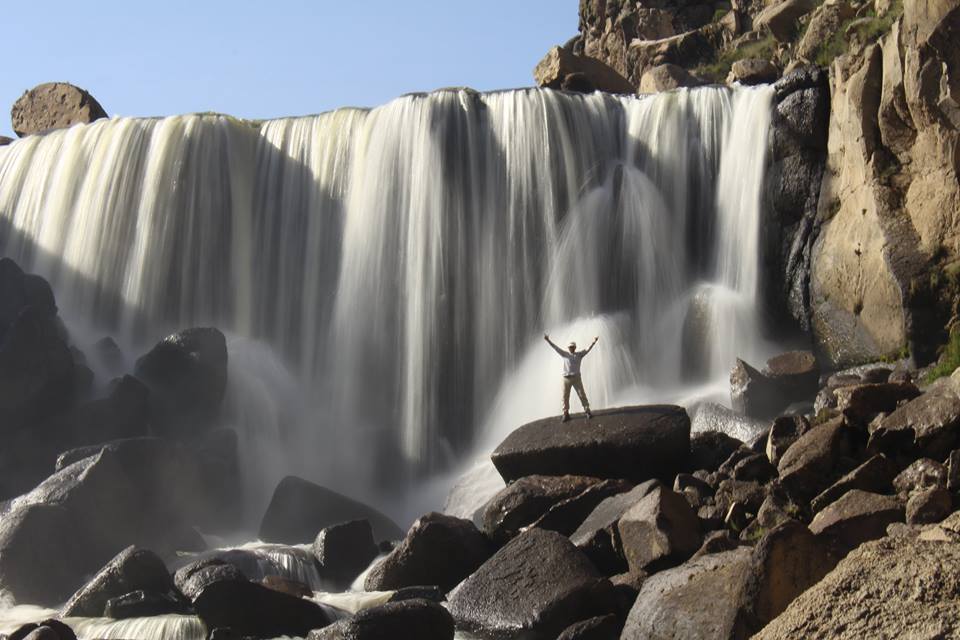
Arequipa is not only it’s ashlar buildings or the excellent gastronomy. Take the advantage of your trip to the White City and discover an alternative destination: Pillones waterfalls, at 4600 m.a.s.l.

For seeing this natural spectacle you must go to the district of San Antonio de Chuca, in the Arequipa, Caylloma, in the 154 kilometer of the Arequipa-Puno road. From this point you must do a 30-minute walk to the left side towards the river. The entrance to the place is S / 2.

Enjoy and relax with the Sounds of Nature’s Symphony at Pillones falls

The best option to reach Pillones with total security is to take a tour from Arequipa. The price includes transfers and an english speaking guide. Remember to go with warm clothes and trekking shoes. In your backpack you can not miss a bottle of water and snacks for the road.

The tour is complemented by a visit to the Imata stone forest. You will spend a nice time in this hidden wonder, you will realize that all efforts were worth it.

When to go?

You can visit this attraction at any time of the year; However, you should consider that during the rainy season (January to March) you can see more water. Do not wait anymore and book a Pillones waterfall tour.

Q’eswachaka The Last Inca Bridge

Located at three hours driving from Cusco (Peru) the Q’eswachaka bridge, which crosses the Apurimac River, has become an important tourist attraction that has gained fame among travelers. The reason: it is the last suspension bridge of the Inca culture, so crossing it is a unique experience for any tourist.

Queshuachaca (possibly from Quechua q’iswa a rope of twisted dried maguey or ichhu, chaka bridge, “rope bridge”, consisting of ropes made of grass and spanning the Apurimac River near Huinchiri, in Quehue District, Canas Province, Peru, is the last remaining Inca rope bridge

Located in the district of Quehue, in the Cusco province of Canas, this impressive bridge made of vegetable fiber (ichu) was part of the Inca Trail. Its validity is approximately 600 years.

At 50 meters high, the 28 meters long and 1.20 wide of the Q’eswachaka are a challenge for tourists. Therefore, every year in June, such construction is renewed by the local communities of Winch’iri, Chaupibanda, Ccollana Quehue and Perccaro. It is a ritual that lasts three days.

Fashionable Masks with Colca Design

Artisans depend on more than 90% of the income generated by tourism, national and international, which, since March 16, is almost nil in the Arequipa region and Peru in general and according to the specialists, will be the last sector in recover, so It’s future is uncertain.

But before the crisis creativity comes out. In Huancavelica, protection masks began to be made with handcrafted designs, and in Arequipa it was developed with Colca designs.

The artisan Condori, started to offer the masks to protect against COVID-19. At 7 years old, Condori was taken to Caylloma until he finished his secondary studies. The art called him so he decided to study at Carlos Baca Flor and became a complete artist. He did dance, music, sculpture, painting, embroidery.

At first he entered as a teacher in an educational institution to teach dance, but he says that there the business is not teaching, but the rental of costumes. “At first dances were performed from different regions, but then Colca became fashionable, so I learned to do embroidery and I started making costumes myself,” he said.

He indicated that these days he decided to make decorative masks for the dance of the Turks. He observed that the quarantine was extended and resources began to run out, so he decided to do something that would urgently generate income for him.

This is how the idea of ​​making masks with the striking designs of the Colca arose and is promoting them through social networks. “It is not a mass production, because only I make them and make them by order,” said the artist.

He says the designs are personalized, some people ask them to embroider their name, others some special badge. For this he uses his sewing machine to which he has added some special needles.

Inside the striking mask has placed a cotton cloth and it is completely washable, the threads do not discolor and it will surely serve so that later, it is kept as a memory of the virus that put the entire world in check.

It works only because it is not an industrial production. “If I hire someone, the work will no longer be mine, the artistic quality would be lost and that is what I intend, that each person who acquires my work can have a product of great artistic quality,” he says.

Andean Condor National Bird of Peru

The Andean Condor National Bird of Peru (Vultur gryphus) is known as the largest flying bird on the planet, this is a Western South American bird and could be found in the Andes. The Andean condor is the largest flying bird in the world by combined measurement of weight and wingspan.

The Vultur Gryphus is a national symbol of Argentina, Bolivia, Chile, Colombia, Ecuador, and Peru and plays an important role in the folklore and mythology of the Andean regions.

The Andean condor can easily live up to 85 years, therefore it is called the “eternal bird” and is characterized by being sedentary and monogamous. It can measure up to 1.30 meters tall, 3.30 meters wide and its maximum weight is 12 kg.


The adult plumage is black, with the exception of a frill of white feathers nearly surrounding the base of the neck especially in the male.

The head and neck are red to blackish-red and have few feathers. In the male, the head is crowned with a dark red caruncle or comb, while the skin of his neck lies in folds. Juveniles have a grayish-brown general coloration, blackish head and neck skin.


The Colca Canyon in Arequipa, Peru is one of the sites, recognized worldwide, as the condor’s habitat where you can observe the flight of this bird.


The Andean Condor and The Incas of Peru

In Andean mythology, the Andean condor was associated with the Inti or sun deity. This bird is considered a symbol of power and health. In some Peruvian bullfighting, a condor is tied to the back of a bull, where it pecks at the animal as bullfighters fight it.

The condor generally survives and is set free.

This ceremony is called Yawar Fiesta which is a symbolic representation of the power of the Andean peoples (the condor) over the Spanish (the bull).

The Best Places for Watching Condors in Peru

These extraordinary birds can live in very high areas with mountainous regions. Among these places are the Colca Canyon in Arequipa, the Moyobamba canyon in Ayacucho or in Chonta, located in Cusco.

Many condors have also been sighted in coastal areas, near the sea. Outside of Peru, they can be found throughout the Andes, from Colombia to Chile.

They can be seen in areas of Argentina, Ecuador and much of Bolivia.

Differences between llamas and alpacas

Is It easy to find the differences between llamas and alpacas?
The recreation of Andean cuisine draws on elements from other cultural landscapes, such as Europe.
What better way to combine healthy cuisine with Novo Andean flavors in Peru, yielding an intense variety of dishes that delight even the most discerning palates.
Discover which foods and ingredients from Peruvian cuisine make Peru a good destination to visit and enjoy.
Differences between Llamas and alpacas: Alpacas may seem very similar to the llamas, but there is a variety of differences between them.
Colca Trek 3 Days inside the second deepest Canyon in the world
Differences between the llamas vs alpacas:

  1. Ears: An alpaca has straight, pointed ears. A llama on the other hand has banana shaped ears.
  2. Wool: Llamas have no wool, rather hair that protects but is not appropriate for a sweater or scarf. Alpacas are bred purely for their luxurious wool which is one of the finest in the world.
  3. Face: The face of an alpaca is a lot fuzzier and woollier than a llamas face. A llamas face is also longer while an alpaca’s face is a bit more blunt.
  4. Size: The llama is a lot bigger while alpacas are a lot lighter. The llama can have a height of more than 110 cm, alpacas are generally not much taller than 90 cm.
  5. Purpose: Llamas are known as the “Ship of the Andes”. Their back is very suitable to carry heavy weights for long distances. Alpacas on the other hand, are all wool.
  6. Personality: Alpacas are very gentle and shy while llamas are very confident and brave animals.
  7. Strength: Alpacas can’t protect themselves and need protection. Llamas on the other hand can and will protect themselves.
  8. Character: Alpacas are very intelligent and can learn tricks. Llamas seem to be too confident/proud and arrogant.
  9. Like minded: Alpacas are 100% herd animals and need tot be in a group to survive while llamas are more independent.
  10. Llamas are known for spitting quickly when they feel threatened, whereas alpacas are much more gentle and just spit as their last resort when they’re really angry or scared.

Ultricies mi eget mauris pharetra et ultrices neque ornare aenean. Neque aliquam vestibulum morbi blandit cursus risus at. Eget egestas purus viverra accumsan. In hendrerit gravida rutrum quisque non tellus orci. Cursus euismod quis viverra nibh cras pulvinar mattis nunc. Imperdiet dui accumsan sit amet.

Header 1

Header 2

Header 3

Header 4

Aliquam ultrices sagittis orci a scelerisque purus. Etiam dignissim diam quis enim lobortis scelerisque

Aliquam ultrices sagittis orci a scelerisque purus. Etiam dignissim diam quis enim lobortis scelerisque fermentum dui. Aliquet eget sit amet tellus cras adipiscing enim eu turpis. Neque gravida in fermentum et. Donec massa sapien faucibus et molestie ac feugiat.

lifestyle photography Refreshment Travel

Tempus imperdiet nulla malesuada pellentesque elit eget gravida. Adipiscing diam donec adipiscing tristique risus nec feugiat in fermentum. Sed felis eget velit aliquet sagittis id consectetur purus ut. Convallis tellus id interdum velit. Quam quisque id diam vel quam elementum pulvinar etiam.

143 New Geoglyphs on the Nasca Lines

New geoglyphs on the Nazca Lines were found thanks to the artificial intelligence technologies helped discover these new figures of humans, plants and animals.

What other mysteries hide the sands of the Pampa de Nasca? This time, a team from the University of Yamagata discovered 143 new geoglyphs in the Nasca and Pampas de Jumana Lines, as well as in nearby areas, representing living beings and other objects.

According to the research of the University of Japan, this discovery was made thanks to the studies that the specialists carried out between 2016 and 2018.

lifestyle photography Refreshment Travel

Most of the geoglyphs were discovered to the west of the area and their age is between 100 BC. and 300 AC.

For the study of the ancestral images, the team of the University of Yamagata had the collaboration of the company IBM Japan. Thus, they managed to identify a geoglyph in the form of a human figure with three decorative elements on its head.

For specialists, it is the first case in which artificial intelligence technologies helped discover new geoglyphs.

An academic agreement regarding research on the Nasca Lines states that artificial intelligence technology at the IBM Thomas J. Watson Research Center in the USA. UU. help the Yamagata research team to better understand the distribution of the Nasca Lines.

Thus, the researchers also intend to prepare a location map based on the results of their fieldwork.

By understanding the Nasca Lines as a whole, they seek to accelerate research and, thus, raise public awareness of the need to protect the World Heritage Site.